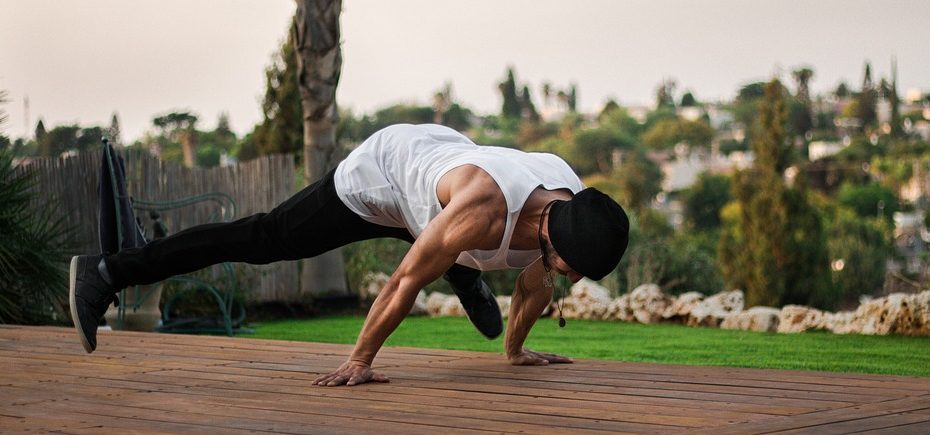
You’ve seen it on social networks, or perhaps at the local park, or maybe at the gym. Some guy doing various tricks on a bar, doing impressive moves or holding his body in such a way that he seems to defy gravity. You ask yourself, how does he do that, and what is that called? That’s calisthenics.
Origin Story
But what exactly is calisthenics? Let’s start with the word itself. The word calisthenics is derived from the ancient Greek words kalos and sthenos. Kalos means “good” or “perfect” and sthenos means “strength”, and so, calisthenics means “perfect strength”. Calisthenics has also been referred to as “street workout” or “bodyweight training”. Ancient man did not have any weightlifting equipment, but as part of everyday life he ran, squatted, lunged, pulled, pushed, climbed and jumped his way around in order to survive the harsh life at that time. As humans moved into more modern eras, calisthenics training became a corner stone of organisations such as the military. It was easy to teach, easy to organize, and it improved the skills and movements that soldiers would use in battle.
Today, especially because of “corona” virus caused restrictions, when gyms are closed for weeks, calisthenics popularity is on the rise. People are looking for alternatives and move away from gyms. In calisthenics there is no need for expensive equipment and it is possible to do workouts at home.
What is Calisthenics Training?
Calisthenics is about using just the human body to perform strength exercises that are rarely seen in other forms of training. Resistance in calisthenics comes exclusively from gravity and your own body weight, hence why it is often referred to as ‘bodyweight training’. Most calisthenics exercises require no equipment at all, while some exercises require minimal equipment (such as pull-up bars and dip bars). The most basic and likely most well known calisthenics exercise is the simple push-up. Calisthenics is often used to build a foundation of strength that cannot be attained through other forms of exercise. Average calisthenics athlete will not look as bulky as average body builder, but can likely match or exceed that body builder when it comes to true strength. Calisthenics athletes also have different kinds of strength, and strength in areas of the body that are often neglected in other training styles. For example, core strength is an integral component of calisthenics training, and you’ll be hard pressed to find a training style that produces a stronger core than calisthenics. Many athletes in the modern era use calisthenics training to build a foundation of strength that can greatly enhance their ability to perform at the highest level of their sport.
The Benefits of Calisthenics Training
There are several key advantages to calisthenics training over other forms of exercises popular today, and we run down some of the most important ones below:
- Wallet friendly. First and foremost, calisthenics does not require an expensive gym membership, and requires little to no equipment. If someone wants to avoid using equipment altogether, they can still complete a full calisthenics program and see amazing results. But there are times when some simple and inexpensive equipment can help take it to the next level.
- Calisthenics can be done anywhere. Park? Perfect. Hotel room? No problem. Living room? Absolutely. Beach? Why not. You get the picture. Because of the simplicity and back to basics approach to the exercises, calisthenics can be done anywhere you have a bit of space. In fact, one of the common alternative terms for calisthenics training is “street workout”. Common practice of performing calisthenics training in public parks or beaches, or even literally on the street.
- You already know how to do it. Because calisthenics exercises are so intuitive and natural, and because you’ve likely already been exposed to the basic movements. This makes it easy to have success and build confidence right now with a calisthenics program. As a result, calisthenics is a very beginner friendly training style.
- Perfectly tailored. Because calisthenics relies purely on body weight for resistance, it tailors itself perfectly to each individual. Exercise difficulty is naturally calibrated to the individual, so that someone who is petite and lightweight who likely doesn’t have as much strength would not be required to lift as much weight right off the bat. Those who are overweight with very little muscle will have a higher degree of difficulty early on which lends itself to the more drastic progress that they’ll need to make.
- Less risk of injury. Calisthenics exercises are much less prone to injury than most other training programs. For one, there is no risk of dropping a dumbbell on your foot. But beyond that, because calisthenics relies on the natural resistance of gravity and your own bodyweight, there is no risk of adding too much weight and overdoing it. Even for the most difficult calisthenics exercises, if beginners are willing to try them before they’re ready, all that will happen is that they’ll be unable to perform the exercise. This is much different than a beginner who tries to bench press way more than he should and drops the bar on his chest.
- Athletic boost. There is a reason that professional sports teams and the military have made calisthenics a core part of their training programms. Calisthenics exercises translate very well to sports and any activity that requires athletic prowess. Because they are full body exercises that allow for a full range of motion, and increase not just strength but flexibility and mobility, calisthenics exercises are extremely beneficial for sports. Core strength also features prominently in calisthenics training, and it’s commonly known these days that core strength is very strongly correlated to better athletic performance.
- Look as good in a suit as you do at the beach. If you want to look naturally strong and super shredded, then calisthenics is perfect for you. Calisthenics exercises naturally shred away body fat while adding massive amounts of real strength. This holy grail of lean strength is what calisthenics is all about. If you’ve seen the body of anyone who is serious about calisthenics, you’ve no doubt come away very impressed. Lastly, because of the significant focus that calisthenics puts on the core, your abs will look incredible.
Calisthenics Exercises
Before anyone starts a calisthenics program, it is recommended that you first master the basics of calisthenics mobility and stretching. This will supercharge your progress and results and help you to master the exercises much more quickly.
Below is a simple list of some of the more common calisthenics exercises, including a brief description of each.
Push-Ups
Probably the most well known of all calisthenics exercises, the push-up has been an effective and easy to learn exercise. In its purest form, the standard push-up requires you to place your hands on the floor, shoulder width apart, while stretching your legs horizontally behind you as you balance on your toes. Then start to bend your elbows and begin lowering yourself to the ground. As you do this, it’s normal for your elbows to push out away from the sides of your body. Lower yourself until your chest touches the ground or comes very close to it, pause for a split-second, and then raise yourself back up until your arms are straight again. This is one repetition, and you can continue this for however many repetitions you’re trying to achieve. Many people don’t realize the range of push-up variations that are possible beyond just the standard push-up.
Pull-Ups
The ‘pull-up’ category of exercises are among the most effective exercises for upper body strength and conditioning. Pull ups impacts mainly the forearms, biceps, back, and core, and are an important component of any calisthenics practitioner’s repertoire. Like the push-up they are quite simple to perform, but generally as people are starting out they cannot perform as many pull-ups as they can push-ups. The term ‘pull-ups’ actually refers to a number of different pulling exercises that can be broken down, in order from least difficult to most, into rows, chin-ups, and pull-ups. For pull-ups alone, there are at least 5 different variations of the exercise that can be performed, each with a greater degree of difficulty.
Dips
Dips are a form of pushing exercise, and therefore dip exercises target the forearms, shoulders, and chest, but most of all dips involve the triceps. The triceps are a key muscle group to build if you’re looking for noticeably bigger arms. Dips are similar to push-ups in that you are required to lift a load that is equivalent to your body weight. Generally, dips requires some sort of simple equipment as a chair or box, but the most effective option is to use dip bars. The most basic dip involves placing your hands on a box behind you, about shoulder width apart. With your hands facing forward, you need to place your legs in front of you while balancing on the back of your heels, with your knees unbent. From here you’ll slowly bend your elbows and lower your body so that your bum gets closer to the ground, and then push back up again to complete one repetition.
Handstands
One of the most sought after calisthenics exercises that people try to master is the handstand, and achieving it is a crowning achievement for any calisthenics beginer. Essentially, the handstand requires you to be upside down on your hands, with the rest of your body shooting vertically up in a straight line, feet point skywards. The handstand may look simple, but it takes a fair bit of training and a combination of focus, strength, and balance to get it just right. Although the handstand is also considered a pushing exercise, it has the added element of requiring significant core strength in order to perform it properly. Achieving a handstand is truly a progression and you’ll want to start with wall walks if you’re new to it, but with time anyone can achieve a handstand.
Levers
If you’ve been following calisthenics at all on social media, you’ve no doubt seen some impressive looking levers. The half lever, front lever, back lever, human flag, and planche all fall within this category. The common element among all levers is the how straight and rigid all the body parts must be in order to perform each properly. This creates an enormous amount of tension in the body and requires a significant amount of strength throughout the core and extremities. Levers are what’s known as “isometric” exercises. It means that you are holding yourself in a static position and not moving. Don’t let that fool you into thinking that levers are easy though, as they are actually some of the most difficult calisthenics exercises to master. Because of the massive amount of force required to properly achieve a lever, performing them regularly can build a massive amount of strength.
Lower Body
Given the most popular calisthenics exercises that most beginners are usually exposed to, it’s easy to assume that the lower body is neglected in calisthenics training. Although the lower body is definitely not featured as prominently as the upper body, there are definitely calisthenics exercises that target the lower body. It’s important to develop an overall physique that is not just top heavy. Lower body strength will also give you a strength advantage and allow for a broader range of movement, even when performing non lower body exercises. Likely the most well known lower body calisthenics exercise is the squat, and modern training programs have come to feature the squat prominently because of the recognized benefits of the exercise. In addition to the squat and all of it’s variations, we also have the lunge, calf raise and bridge.
Calisthenics Equipment
As mentioned, it’s not totally necessary to use equipment in order to do calisthenics. You can follow a pretty decent calisthenics program and see great results without every touching a piece of equipment. Also, although many calisthenics exercises can be done without equipment, one of the most effective, the pull-up series, really needs a pull-up bar. Not to worry though, as the essential calisthenics equipment is quite inexpensive, especially compared with other exercise equipment on the market.
Below, we’ll summarize some of the most common equipment with a brief description.
Pull-Up Bar
Pull-up bars can be used not just for the pulling exercises, but for many of the core and pushing exercises as well. This versatility makes it probably the most essential piece of calisthenics equipment you can own. There are several types of pull-up bars on the market, ranging from those that bolt onto a wall, to ones that fit in door frames, to those that are completely stand alone units.
Parallettes
Parallettes are sometimes known as push-up bars, and they are certainly used for push-ups, but their use goes beyond push-ups and involves exercises such as the planch and handstands. Parallettes are essentially two bars that are low to the ground and that you place on the floor some distance apart. They are not that large and therefore very portable, allowing you to take them almost anywhere.
Dip Bars
Dip bars are an essential piece of equipment for triceps dips, but can be used for an array of other calisthenics exercises such as levers, handstands, and planches. Dip bars are very similar to parallettes in that they are a set of two bars that are placed some distance apart, but the bars are higher than parallettes, allowing space for your body to hang. Much like parallettes, the key for good dip bars is to make sure they are made from quality material and sturdy, and that the grips are comfortable and wide enough.
Beginner Calisthenics Programs
The most important factor for those that are new to calisthenics is to get the exercises right in terms of doing them properly. Early on, it’s important to focus on your form as opposed to being worried about how many reps you can do, because if you’re not doing the exercises properly then you won’t see real results.
For those who are absolutely new to calisthenics, and who maybe don’t work out on a regular basis, I like to recommend a simple overall body routine to get started.
Calisthenics Nutrition
Nutrition is as essential for calisthenics training as for any other sports, but let’s briefly touch on a few key points about diet here.
- Eat real food. One of the most important decisions you can make in your diet for both health reasons and in order to see the best results from your training is to stick to what nature gave us. This means try to limit your intake of processed foods from a box or can, and junk foods like chips and candy bars. Real food means vegetables, whole grains, chicken, beef, fish, and fruits. Try to cook more often then eating out in order to eat healthier and to save a few bucks.
- Increase protein. Protein intake is essential when training for strength, as it is the nutrient responsible for the growth of muscle. Protein packed meals also help to keep you satiated and your blood sugar levels in check, both important factors for controlling appetite and not accumulating fat. All types of meat and fish have a good amount of protein, and it can also be found in many dairy foods such as eggs, milk, cheese, and yogurt. Legumes, nuts, and seeds, also have a healthy amount of protein.
- Reduce carbs. Because of their very high energy density and tendency to spike your insulin levels, carbs should be minimized in a calisthenics training diet. The response in the body from eating a lot of carbs can lead to increased fat storage and the tendency to never feel satisfied and therefore over-eat. Now of course, you don’t need to eliminate carbs completely from your diet, but try to keep them to a minimum. Whenever possible stick to unrefined carbs such as whole grains.
- Drink lots of water. In reality, most of us don’t drink enough water. It’s important to drink plenty of water to stay hydrated throughout the day, and even more so if you’re doing a training program like calisthenics. Water is the most essential element for all of your body’s processes, and when you become dehydrated those processes begin to break down, which is not what you want when you’re training. Drink water before, after, and during training sessions to ensure you remain hydrated. Lastly, it’s best to stay away from the sports drinks which can be laden with sugar and don’t work any better at hydrating you than water.
So I hope you are inspired enough to take your first step and make first pull-up right now!